
Chiang Mai’s Burning Season is not a vague regional haze problem: NASA estimates that biomass burning accounts for about 70% of the city’s April PM2.5, with fire activity usually peaking in March before rains begin reducing smoke by May. That seasonal pattern explains why annual figures can understate the disruption. IQAir recorded Chiang Mai’s 2025 annual PM2.5 average at 18.2 µg/m³, yet the monthly average reached 53.5 µg/m³ in March before falling to 8.2 µg/m³ in May.
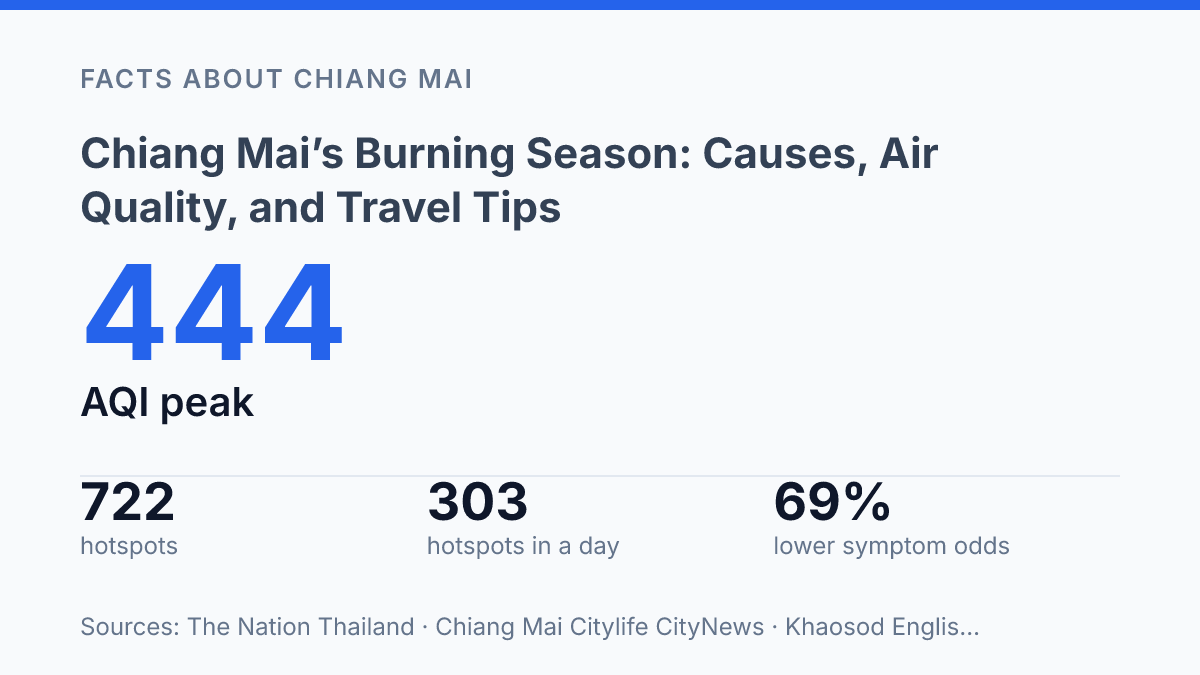
During severe weeks, the change is sharper still: on 31 March 2026, authorities counted 303 hotspots in Chiang Mai in a single morning. The issue is therefore both environmental and practical, shaping daily visibility, respiratory risk, trip timing, and the quality of indoor spaces when smoke persists beyond a few bad afternoons.
Why the haze builds each dry season
The NASA Earth Observatory estimates that about 70% of Chiang Mai’s PM2.5 in April comes from biomass burning, making open burning the dominant source during the late dry season rather than a minor background factor. Much of that burning is agricultural: in northern Thailand, some farmers burn leftover crop stubble to clear fields quickly and return nutrients to the soil before the next planting cycle. This practice is often described as slash-and-burn farming, although the smoke problem also includes smaller field fires, unmanaged burning, and regional fire activity beyond any single district.
Dry weather turns those fires into a wider seasonal pollution problem. From January through April, rainfall is limited, vegetation dries out, and controlled burns are more likely to spread or coincide with forest fires in the mountains around the city.
Fire activity typically peaks in March before fading by May as rains increase, according to NASA’s seasonal observations. The timing matters because the same lack of rain that allows fields and forest fuels to ignite also removes one of the atmosphere’s main cleaning mechanisms: wet deposition, where rain helps wash particles out of the air.
Chiang Mai’s terrain then makes the smoke harder to disperse. The city sits in a basin-like valley encircled by mountains, so air movement is more restricted than it would be on an open plain or along a windy coast.
Under dry-season conditions, stagnant air and temperature inversions can keep smoke close to the ground, allowing fine particles from farms, forest fires, and regional burning to accumulate over several days. This is why the haze is best understood as a combined seasonal system: burning produces the particles, dry weather increases both fire risk and persistence, and the valley setting concentrates what the fires release.
What air quality looks like from January to April
In March 2025, Chiang Mai’s monthly PM2.5 average reached 53.5 µg/m³, more than six times its May average of 8.2 µg/m³, according to the IQAir World Air Quality Report. That contrast captures the seasonal pattern: the main smoke window runs from January through April, but the worst measured pollution is concentrated near the end of the dry season, especially in March and early April.
The visible effects during severe weeks are hard to separate from the measurements. Heavy grey haze can flatten the city’s skyline, obscure mountain views, and reduce visibility on roads and at viewpoints. The main health-relevant pollutant is PM2.5, fine particulate matter small enough to remain suspended in the air and drive unhealthy outdoor conditions when concentrations rise.
Peak episodes can be both intense and sustained. During a severe event on 3 April 2026, The Nation Thailand reported that all six monitoring stations in Chiang Mai were above 100 µg/m³ for PM2.5, while Mueang Na in Chiang Dao recorded AQI 444 and 318.3 µg/m³ PM2.5. Figures at that level indicate conditions far beyond routine haze, with outdoor exposure becoming a practical concern for residents, workers, and visitors.
This timing aligns with satellite-based seasonal observations. According to NASA Earth Observatory, about 70% of Chiang Mai’s PM2.5 in April comes from biomass burning, with fire activity typically peaking in March and fading by May as rains increase.
The return of rain and shifting weather patterns can clear the air quickly, but the change does not follow a fixed calendar date. Late April may bring relief in some years, while in others smoky conditions can persist until more consistent rainfall arrives in May.
Health and travel planning for smoky weeks
In a February–May 2024 visitor study published in Journal of Travel Medicine, 58.8% of Chiang Mai travellers reported short-term symptoms, compared with 0.4% among Bangkok travellers in the same research. The study also found that reducing outdoor activity was associated with 69% lower odds of symptoms, which makes daily planning a health measure rather than a matter of comfort alone. During smoky weeks, the practical decision is often whether an outdoor plan should proceed, be shortened, or move indoors.
For date selection, the lower-risk travel window is November to January, when clearer air and more comfortable weather are generally more likely than during the smoky late-dry-season period. This does not mean every short visit outside that window is unsafe, but it does shift the risk calculation. Travellers with asthma, chronic bronchitis, cardiovascular disease, young children, older adults, or pregnancy have less margin for repeated exposure when pollution readings are high.
Daily conditions should be checked with IQAir or Air4Thai before going outside, because conditions can change enough within a day to affect plans. A high reading should weigh against long walks, outdoor markets, temple climbs, cycling, and open-air transport, especially when those activities would last for several hours. Short essential trips are easier to manage if exposure time is limited and routes avoid heavy traffic as much as possible.
An N95 mask is the appropriate outdoor protection when air quality is poor, provided it fits closely around the nose and cheeks. Loose cloth or surgical masks do not filter fine particulate matter with the same reliability, so they are not equivalent during smoke episodes. Masks are most useful as part of a broader exposure strategy: checking the air first, reducing time outside when readings are unhealthy, and treating symptoms such as wheezing, chest tightness, or persistent coughing as reasons to reduce exposure further.
Indoor protection when the haze lingers
Indoor smoke exposure still has measurable health relevance: a 2026 Scientific Reports study following 27 Chiang Mai office workers over eight weeks found that each 10 µg/m³ rise in indoor PM2.5 was associated with 3.99 times higher odds of nasal symptoms. The finding matters because staying inside reduces direct contact with smoky outdoor air, but it does not remove fine-particle exposure when buildings leak, doors open frequently, or filtration is weak.
A HEPA air purifier is one of the most practical ways to reduce indoor fine particles during prolonged haze. The unit should be matched to the size of the room, since an undersized purifier may circulate air without cleaning it quickly enough.
Filter quality also matters: true HEPA filtration is designed to capture fine particles efficiently, while poorly specified or overdue filters can give a false sense of protection. For bedrooms, running the purifier continuously with doors closed is usually more effective than moving one device between several rooms.
Keeping polluted outdoor air from entering is the second half of indoor protection. During severe smoke episodes, windows should remain closed, balcony doors should be opened as little as possible, and gaps around doors or window frames can reduce the benefit of filtration. Air conditioning can help with comfort, but it is not automatically the same as particle filtration unless the system has an appropriate filter and does not draw in large amounts of unfiltered outside air.
Accommodation choice can make a substantial difference when haze lasts for days or weeks. Hotels, serviced apartments, and guesthouses with well-sealed rooms, functioning air conditioning, and verified in-room filtration offer better exposure reduction than airy buildings designed for natural ventilation.
Before booking during smoky months, it is reasonable to look for properties that specifically mention HEPA purifiers or filtered ventilation rather than relying on vague claims of “clean air.” Indoor air cannot be made perfectly clean in these conditions, but sealing, filtration, and room choice can meaningfully reduce the amount of PM2.5 inhaled while indoors.
What the smoke calendar changes about planning
Late-dry-season travel in northern Thailand is best treated as conditional rather than fixed. A March itinerary may still work, but the evidence supports plans that can change with measured PM2.5, not just weather forecasts or general seasonal expectations. Flexible accommodation, fewer outdoor commitments, access to filtered indoor spaces, and clear thresholds for postponing hikes or motorbike trips turn air quality data into practical risk control.
The same logic applies to residents and long-stay visitors: indoor protection is not secondary when office-based research in Chiang Mai has linked higher indoor PM2.5 to increased nasal symptoms. The practical consequence is simple but specific: during smoky weeks, the safest schedule is the one designed to be revised.
Frequently Asked Questions
Q: When is Chiang Mai’s burning season at its worst?
A: Chiang Mai’s burning season runs from January through April, with pollution typically peaking sharply in March. Conditions often improve by late April or May as rains and weather shifts begin to clear the air. The worst period is usually the late dry season, when smoke buildup is strongest.
Q: Why does the air quality get so bad in Chiang Mai during this period?
A: The main causes are slash-and-burn farming, seasonal forest fires, and the city’s geography. Smoke from burning crop stubble and wildfires collects in a valley surrounded by mountains, which traps polluted air near the ground. That combination can quickly push PM2.5 levels into hazardous ranges.
Q: Is it safe to travel to Chiang Mai during burning season?
A: Travel is possible, but outdoor conditions can be unhealthy and visibility may be poor. People with respiratory conditions, children, and older adults are more likely to be affected by high PM2.5 exposure. Many travelers avoid the period from January through April and choose November to January instead for clearer air.
Q: What should travelers do to protect themselves from smoke in Chiang Mai?
A: An N95 mask is recommended outdoors when air quality is poor, because it filters fine particulate matter better than cloth or surgical masks. Indoor air can also be improved with a HEPA filter or air purifier. Checking daily conditions before going out helps reduce exposure on the worst days.
Q: How can I check Chiang Mai air quality before planning activities?
A: Air quality is commonly tracked with AQI readings and PM2.5 measurements, which show how much fine pollution is in the air. Services such as IQAir and Air4Thai provide daily updates that can help identify the safest times for outdoor activity. Monitoring these reports is especially useful in March, when pollution often peaks.