
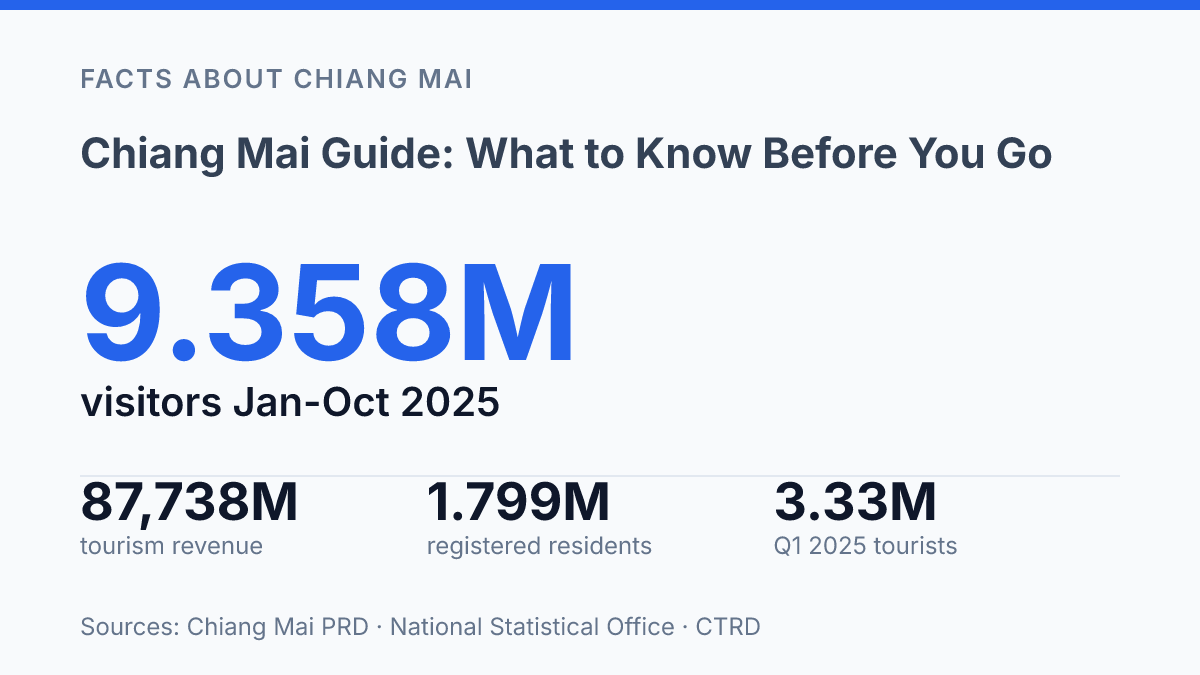
Chiang Mai recorded more than 9.35 million visitors from January to October 2025, yet its scale is not defined by tourism alone: the province had 1,799,019 registered residents in 2024. That contrast explains why first impressions can be misleading. The walled Old City is compact, almost square, and easy to read on a map, but the wider urban area functions as a major northern Thai center for culture, transport, commerce, crafts, and design.
The difference matters for planning: temple districts, markets, Nimmanhaemin cafés, airport links, and creative networks belong to connected but distinct parts of the city rather than one walkable sightseeing zone. This guide sets the historic core beside the modern center, then examines the practical patterns behind arrival routes, local movement, and the city’s reputation beyond sightseeing.
Where Chiang Mai is and why it matters
Roughly 700 kilometers north of Bangkok, Chiang Mai sits far enough into Thailand’s upland north for mountains to shape daily weather, travel times, and the city’s regional role. Administratively, it is the capital of Chiang Mai Province, a northern Thai jurisdiction that anchors the upper part of the country rather than the central plains around Bangkok. The wider province had 1,799,019 registered residents in 2024, according to the National Statistical Office, which helps explain why the city functions as a major provincial center rather than a small upland town.
The urban area lies along the Ping River, one of the main river systems of northern Thailand, in a basin edged by foothills leading into the mountainous north. That setting gives the city much of its geographic appeal, with hill country close by while the central districts remain low enough for a broad, settled valley. The same geography also affects climate: mountains and elevation can soften conditions, but they do not make the city cool year-round.
Seasonal timing matters more than altitude for understanding the weather. The cool, relatively dry season usually runs from November to February, when mornings and evenings can feel noticeably milder.
March to May is the hot season, often with the most intense daytime heat, while the monsoon period from about May or June through October brings the bulk of annual rainfall. This pattern makes the city’s northern setting distinctive, but not exempt from Thailand’s tropical heat and wet-season rhythm.
How the old city and modern center differ
A moat about 20 meters wide makes the historic core one of the easiest parts of the city to read on a map and on the ground. The old city follows an almost-square plan of about 1,600 meters per side and covers 264 hectares, according to the provincial World Heritage project, with remnants of walls and gates giving the center a clear physical boundary. This geometry shapes the visitor experience: streets are shorter, landmarks are closer together, and the sense of place is tied closely to the former fortified capital rather than to later commercial growth.
Inside that square, heritage is unusually concentrated rather than scattered across isolated monuments. The same heritage source lists 44 temple sites within the walls, including 37 active temples and 7 abandoned sites, which explains why religious architecture remains part of daily urban life rather than only a sightseeing category. Wat Phra Singh and Wat Chedi Luang are useful examples because they anchor the old city’s historical identity without requiring a long itinerary; their presence signals the older role of the core as a political, ritual, and residential center.
Newer districts feel organized around consumption, accommodation, and evening activity more than around the old defensive grid. Nimmanhaemin, often shortened to Nimman, is associated with cafes, boutique hotels, design shops, restaurants, and a younger student-and-creative crowd linked partly to nearby university areas. The Night Bazaar area, by contrast, is more visitor-facing in tone, with hotels, markets, souvenir shopping, restaurants, and entertainment clustered around commercial streets outside the old walls.
The practical difference is not that one area is “authentic” and the other is not, but that they serve different trip priorities. The old city concentrates walkable heritage, temples, guesthouses, and a quieter street pattern, making it well suited to history-focused stays and first orientation. Nimmanhaemin and the Night Bazaar districts offer broader hotel choice, more contemporary dining, and stronger nightlife or shopping access, so they often appeal when comfort, evening options, or a more modern urban rhythm matter more than immediate proximity to historic sites.
What Chiang Mai is known for beyond sightseeing
Since 2017, UNESCO has listed the city as a Creative City of Crafts and Folk Art, turning a long craft identity into an internationally recognized part of its economy. The UNESCO Creative Cities Network notes that this sector includes 159 established enterprises, a figure that helps explain why local craft is not limited to souvenir stalls or heritage display. Woodwork, ceramics, textiles, silverwork, lacquerware, and paper products all sit within a broader Lanna cultural tradition in which design, ritual use, and household production have historically overlapped.
That craft base is visible in markets, but the markets also function as distribution points for food producers, small retailers, and independent makers. Weekend walking streets, neighborhood markets, and specialist craft outlets connect visitors with local production, while also serving residents rather than operating only as tourist showcases. According to Thailand’s Creative Economy Agency, the city’s design week supported more than 900 artists and designers and generated 5,361.56 million baht in economic value for northern Thailand across 2018–2023, showing how craft and design activity can extend beyond direct visitor spending.
The university presence gives the city another identity that is easy to miss in a short sightseeing itinerary. Chiang Mai University anchors a large student and academic community, supporting demand for rental housing, clinics, bookstores, cafes, language schools, research activity, and cultural programming. This helps explain why some districts feel young and service-oriented even when they are not centered on major monuments.
The common image of the city as a slower alternative to Bangkok is partly accurate, but incomplete. The province had 1,799,019 registered residents in 2024, according to Thailand’s National Statistical Office, and its daily economy includes education, health care, retail, hospitality, creative production, and longer-stay foreign residents. Its digital-nomad reputation fits within that mix: coworking spaces, flexible rentals, and cafe work culture are visible, but they are one layer of a more varied urban economy rather than the city’s defining industry.
Getting there and moving around the city
The clearest measure of access is the airport’s scale: Chiang Mai International Airport handled 8,821,875 passengers and 57,783 aircraft movements in fiscal 2024, according to a 2025 BOI/AOT update. That makes air travel the main practical gateway for most visitors, with domestic services linking the city to major Thai hubs and international flights giving it direct regional reach. For arrivals without a prearranged transfer, the airport’s official transport options include an R3 city bus loop with a flat fare of 30 baht per trip, according to Airports of Thailand transport information accessed in 2026.
Movement inside the central area is usually simple because short distances can often be covered by walking, shared red songthaews, metered or app-based taxis, and tuk-tuks. Songthaews are common for short urban hops and operate more flexibly than fixed-route buses, though fares and routing may depend on the driver and passenger mix. Taxis and ride-hailing services provide clearer point-to-point travel, which can be useful for luggage, late arrivals, or destinations outside the most walkable streets.
Motorbike rental is widely available, but it changes the risk profile of a trip rather than simply adding convenience. Traffic flows can be unpredictable, parking rules vary by area, and police checks may require an appropriate license or international driving permit. Helmets, travel insurance terms, and local road conditions are therefore practical considerations, not afterthoughts.
The compact core can make the city feel easier to navigate than its wider urban footprint suggests. Short central journeys may be quick, but cross-city travel can slow down when roads are congested or when accommodation, restaurants, universities, malls, and residential districts are spread across suburban corridors. The result is a city that is easy to enter and manageable at the center, yet less compact once daily movement extends beyond the core.
Why the city’s scale changes the trip
Future visits are likely to be shaped by two forces moving at the same time. Heritage protection has become more formal, reflected in the World Heritage nomination dossier prepared for a January 30, 2026 submission deadline, while visitor access keeps expanding through an airport that handled 8.82 million passengers in fiscal 2024. Those trends can support preservation and wider economic activity, but they also make location choices more consequential.
Staying inside the moat, near Nimmanhaemin, or close to transport routes creates different versions of the same trip. The practical result is clear: the city rewards planning by district, because its most important experiences are close together on paper but not always equivalent in time, cost, or context.
Frequently Asked Questions
Q: What is the best time of year to visit Chiang Mai?
A: The most comfortable period is usually the cool, dry season from November to February. Temperatures are lower, rainfall is limited, and outdoor sightseeing is easier to plan. March to May is typically hotter, while the rainy season can bring frequent showers that affect travel timing.
Q: How many days are enough for Chiang Mai?
A: A stay of 3 to 5 days is enough for most first-time visitors. That allows time for the old city, a temple visit, a day trip, and at least one food or market-focused evening. Longer stays make sense for travelers who want slower pacing or nearby mountain trips.
Q: Is Chiang Mai safe for tourists?
A: Chiang Mai is generally considered a safe destination for visitors, especially in central areas and well-traveled parts of the city. As in any busy tourist area, petty theft and road safety deserve attention. Standard precautions such as securing valuables and using reputable transport are usually sufficient.
Q: What should first-time visitors not miss in Chiang Mai?
A: The old city is the best starting point because it concentrates many of the area’s major temples, historic streets, and cultural sites. Night markets and local food stalls are also central to the city’s appeal. A short day trip outside the center can add a different perspective, especially for visitors interested in nature or hill scenery.
Q: Do I need a car in Chiang Mai?
A: A car is usually not necessary for staying in the city center. Many visitors rely on walking, ride-hailing, tuk-tuks, or organized transport for day trips. A car becomes more useful for independent travel to outlying areas, but traffic and parking can make it less convenient inside the main city.